Statement of Solidarity with the Bradford community, McKean County and Save Bradford Hospital Groupfrom the regional Healthcare Rights Committees of Put People First! PA
“We Get Sick, They Get Rich! It Does Not Have To Be Like This”
These lines are from a song written by one of our members about the crisis in our healthcare system. We are a group of everyday people from across the state whose families and friends have been hurt, harmed or killed by a healthcare system that uses our sickness for profiteering and puts money over our lives.
We have also experienced the gutting of our hospitals bit by bit. The closing of labor and delivery units and emergency rooms. The reduction of in-patient beds. We have also experienced the profiteers who came in with big plans and left with broken promises.
We have also experienced job loss, and the loss of identity when the hospitals where we – our babies, cousins, nieces and nephews were born – are gone. These aren’t just buildings, they’re community institutions that generations of families have worked, contributed to, and benefited from.
We see you. We appreciate all that you have done to fight to keep Bradford Regional Medical Center alive.
At our National Day of Action last September, we held a sit-in at Crozer-Chester Medical Center in Delaware County. All four hospitals in the Crozer system have now been closed by private equity in Southeast PA.
After years of meetings with elected officials, thousands of conversations with other impacted community members, our own research, and linking up with people across the state and the nation in the same predicament – we came together to say “enough is enough”.
After being told “we don’t need hospitals anymore” and “there’s nothing we can do” by power-holders we had to escalate – nonviolently. Just a stone’s throw from where MLK went to seminary, we followed in his footsteps by breaking the law to stand up to a system in which there is no law to prevent a hospital from closing. This video shares a glimpse into that day.
Now, there is talk of bringing healthcare services back to the site of Crozer-Chester hospital. There are many entities working on this and we are proud to be among them on the front lines of this struggle. We ultimately work toward a publicly run community hospital that can bring an end to the backroom deals once and for all.
We have seen the news reports saying “there is a good announcement coming” in your situation. We are with you and we are praying for a positive outcome for the Bradford community. Thank you for all that you do to put people first!
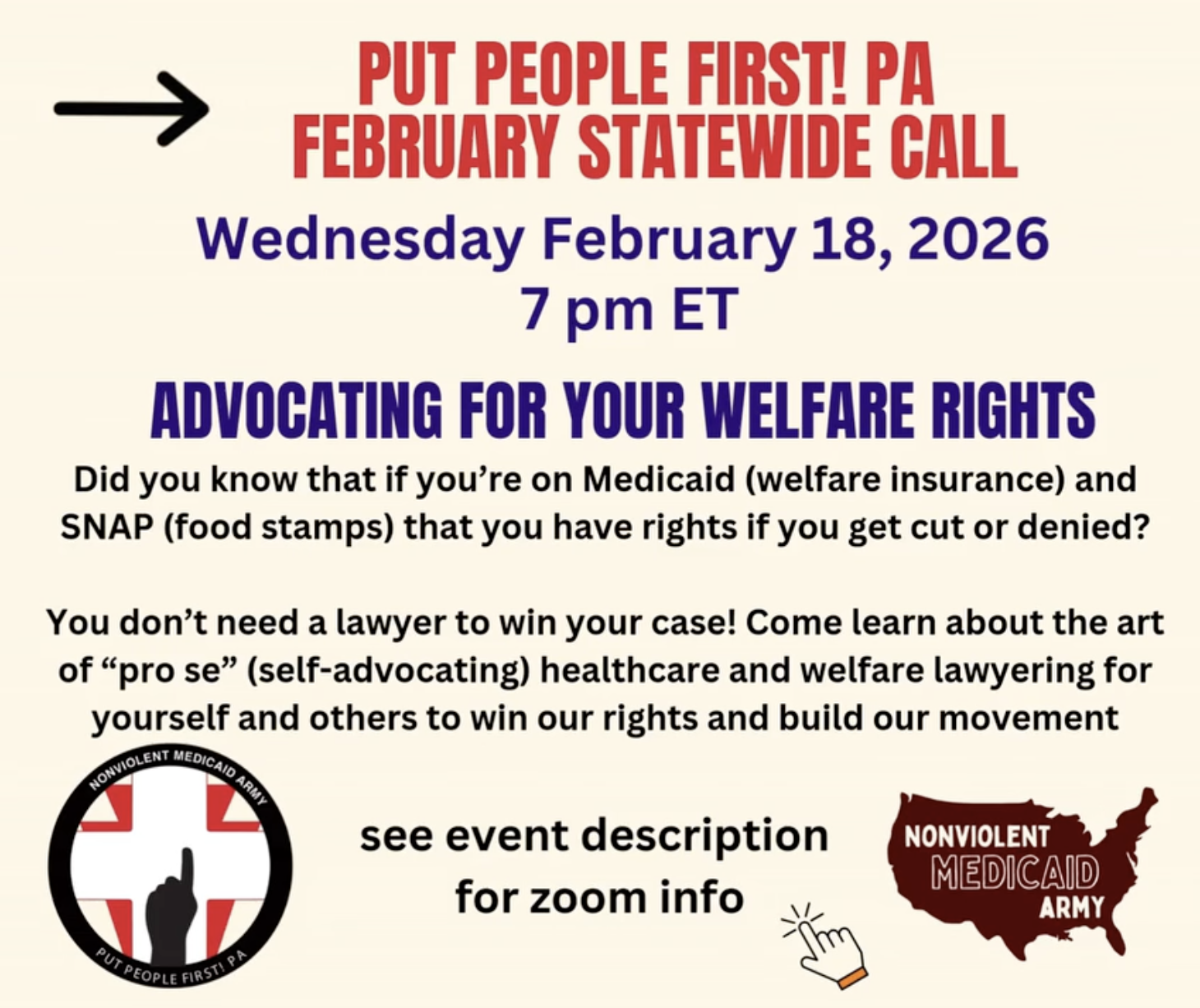
February Statewide Call: Advocating for your Welfare Rights
Join us TONIGHT, February 18 at 7 PM ET. Zoom info below. Every third Wednesday of the month from 7-8 pm ET, Put People First! PA, a statewide, member-led, staff-free organization holds our Statewide Membership Call. This call is for active members, mobilizers, and anyone who is interested in finding out more about our Healthcare is a Human Right campaign and getting involved! This month’s call will be about advocating for your rights to Medicaid (welfare insurance) and SNAP (food stamps).
Did you know that if you have Medicaid or SNAP that you have rights if you are cut or denied?
In Put People First! PA we have learned through experience and struggle how to advocate for ourselves. We have a 93% success rate winning Medicaid appeals for our people! Folks always ask us if we have lawyers, but we have learned how to navigate the system ourselves! This is called “pro se” or self-advocacy healthcare and welfare lawyering. And YOU can learn it too.
Click here to join the call tonight: https://zoom.us/j/5483957623 Or to call in, Dial: 646 558 8656 (US Toll) Then enter Meeting ID: 548 395 7623
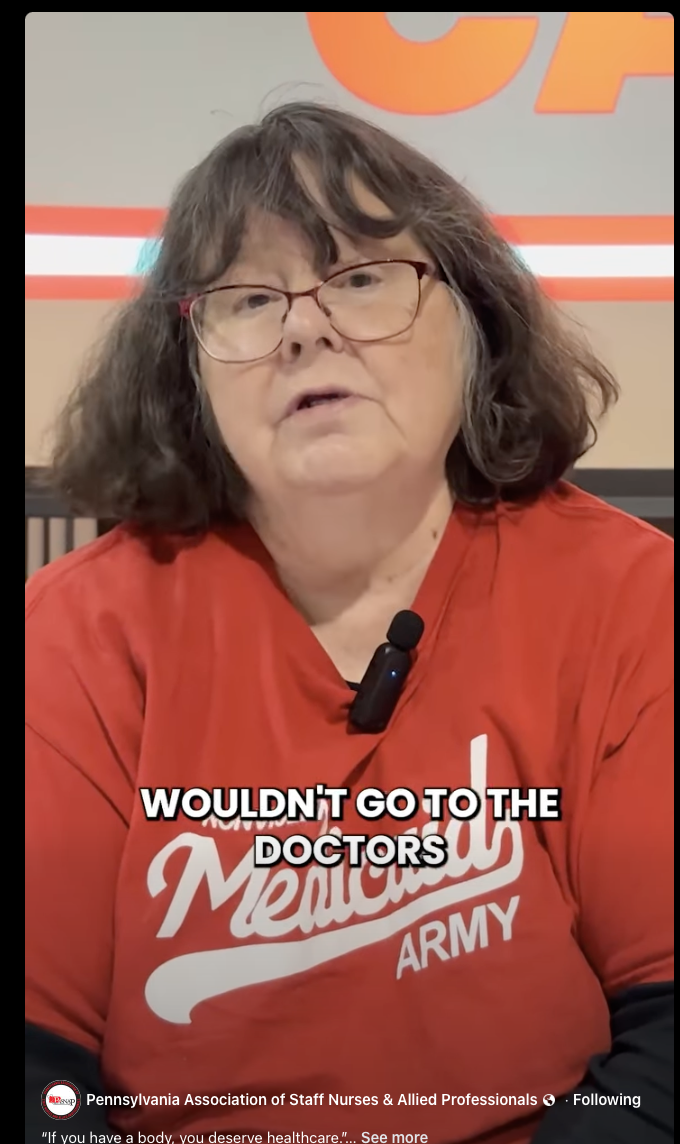
New Video: Southeast PA Leader Robin shares Healthcare Story
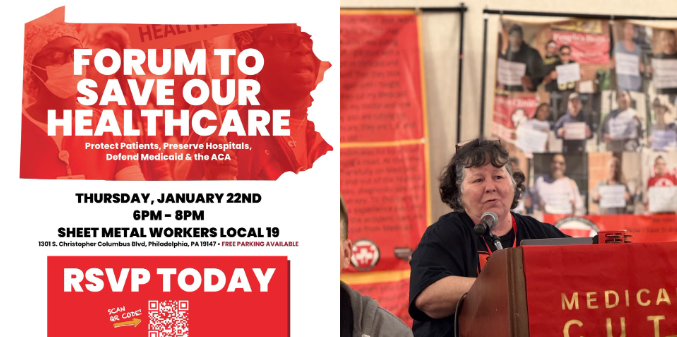
On Thursday, January 22, Put People First! PA joined PASNAP (Pennsylvania Association of Staff Nurses & Allied Professionals) and other unions and community groups for the Forum to Save our Healthcare! Click here to see Robin share her story and how Put People First! PA is fighting back.
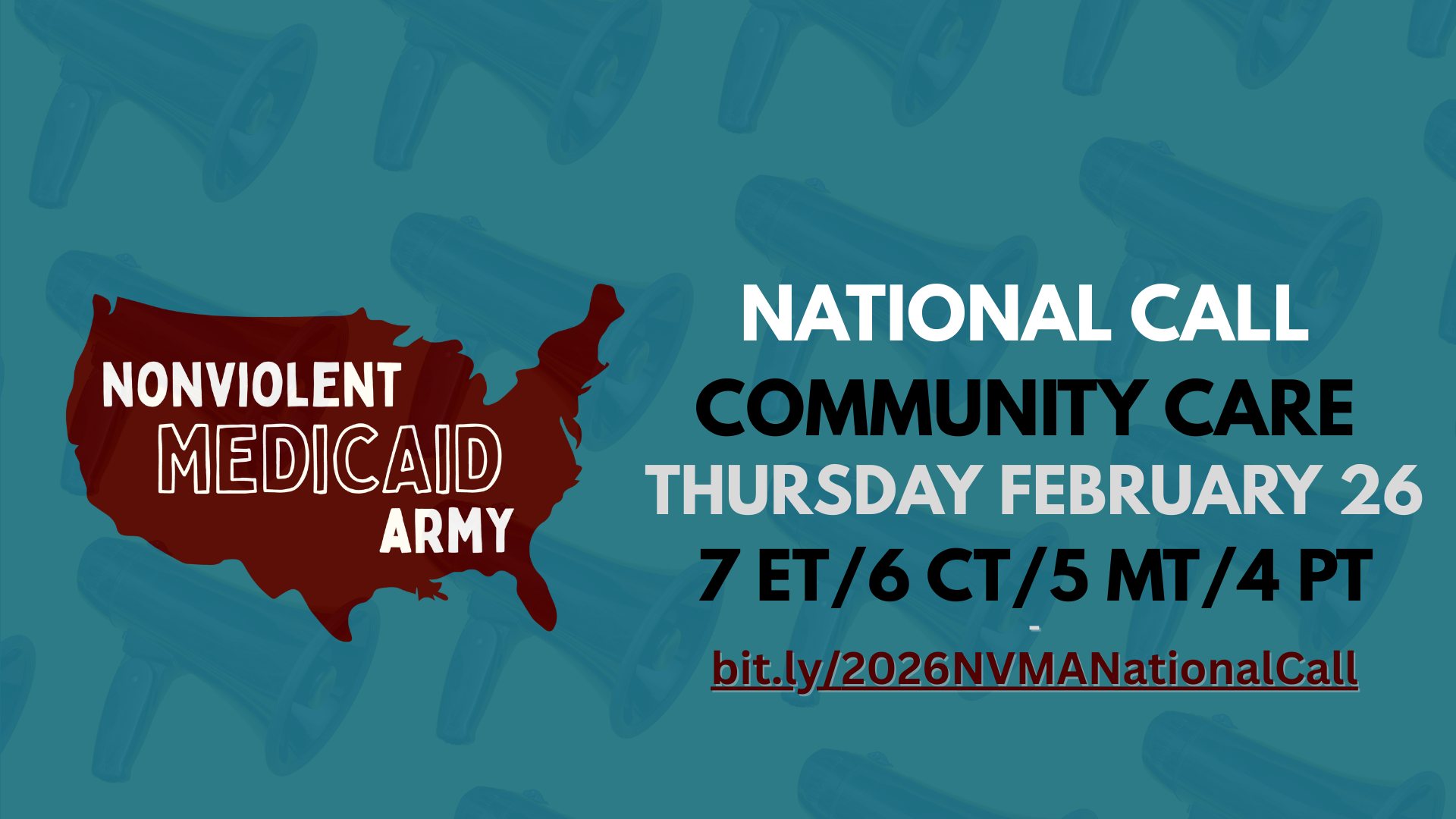
Nonviolent Medicaid Army National Call: Community Care
Join the Nonviolent Medicaid Army on our Monthly National Call, next Thursday, February 26 from 7 – 8 PM ET. This month’s topic is Community Care. We’ll discuss:
How is community care different from self care?
Why does community care have to be centered in our work of the poor organizing the poor?
What is our approach to community care and how is it different from mutual aid or charity?
What are our approaches to emotional and material support?
What are the limits of community care and how does that connect to our building of power for the poor?
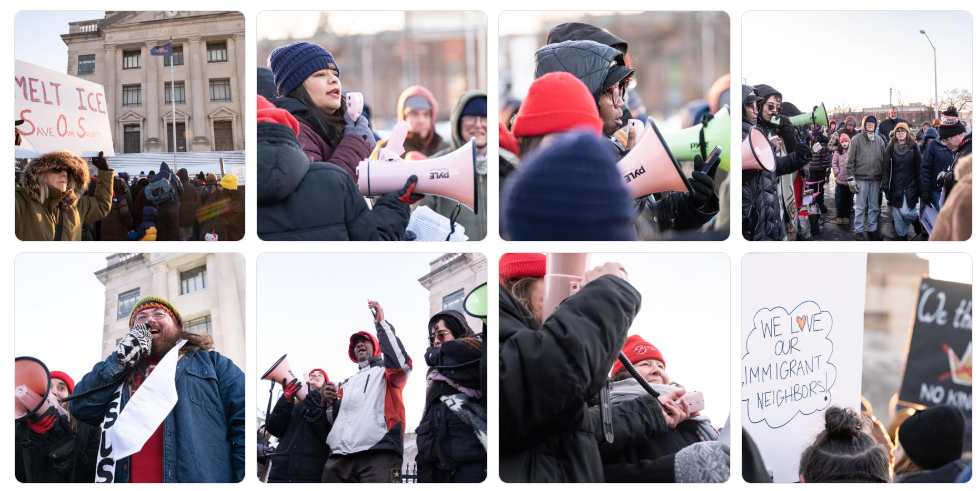
“Hospitals in, ICE out! Housing in, ICE out!” Vigil in Southeast PA
On Friday, January 30, over a hundred community members gathered in Upper Darby, Delaware County for a peaceful vigil and protest to demand together that the government stop violent attacks on our communities and instead fund our basic needs like housing, hospitals, healthcare, food and public safety. Put People First! PA joined with MILPA – Movement of Immigrant Leaders in PA – the National Union of the Homeless, and a number of other Delaware County community organizations to shed light on the connection between attacks on our immigrant communities and attacks on the whole poor and dispossessed working class. Click here to see the photo report back of this powerful vigil!
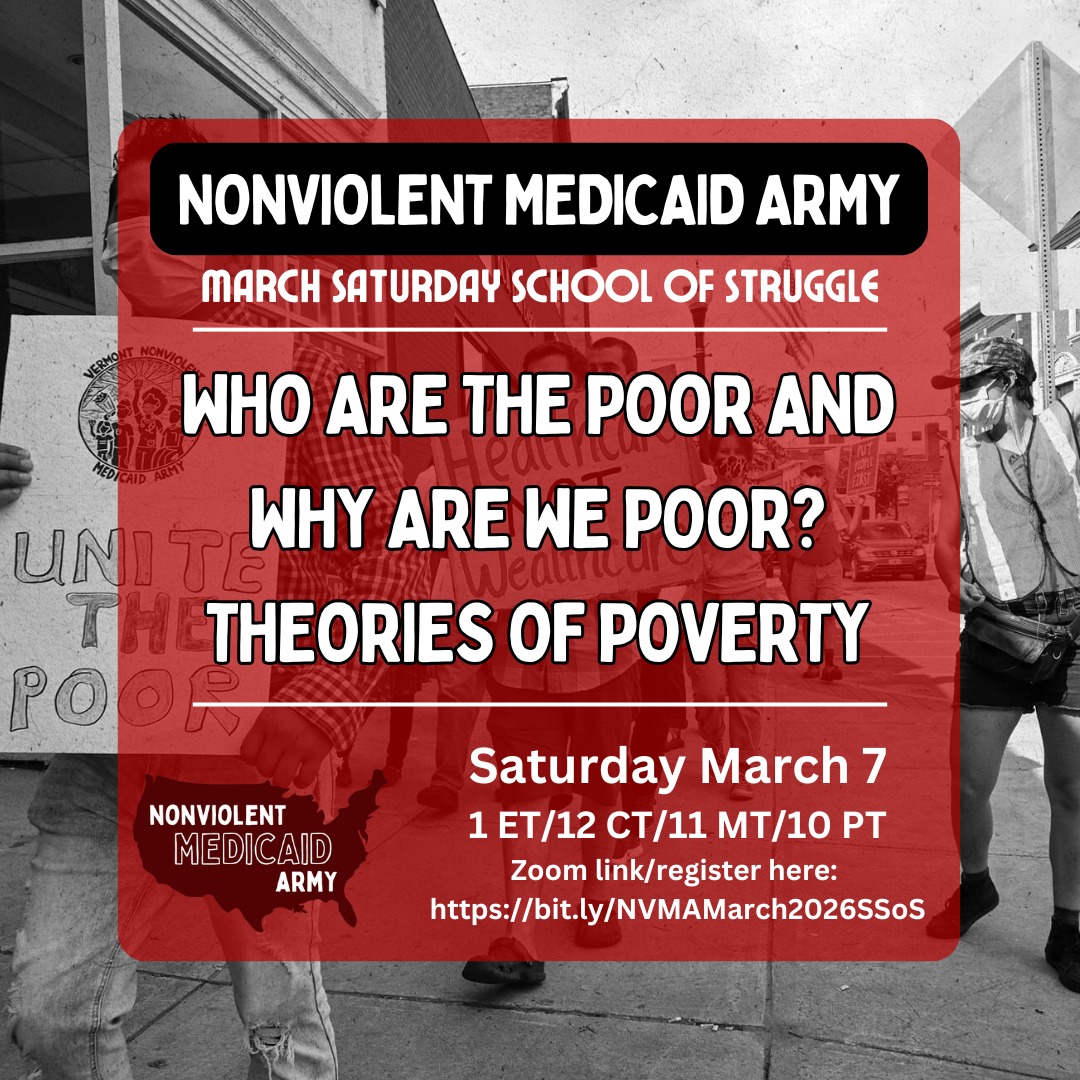
NVMA March Saturday School of Struggle: Who are the Poor and Why Are We Poor?
Join the Nonviolent Medicaid Army for the March 2026 Saturday School of Struggle on Saturday, March 7 from 1 – 2:30 PM ET! Who are the Poor and Why are We Poor? Theories of Poverty and Theories of Change.
Put People First! PA is organized into five regions: Southeast, Southwest, Central-Appalachia, South Central and Northeast. In each of these regions, members participate in twice a month meetings held by phone and online, organized around our healthcare struggles. If you’re new to Put People First! PA, attend a monthly Statewide Call or Saturday School or click here to contact any of the Coordinators listed to learn more.
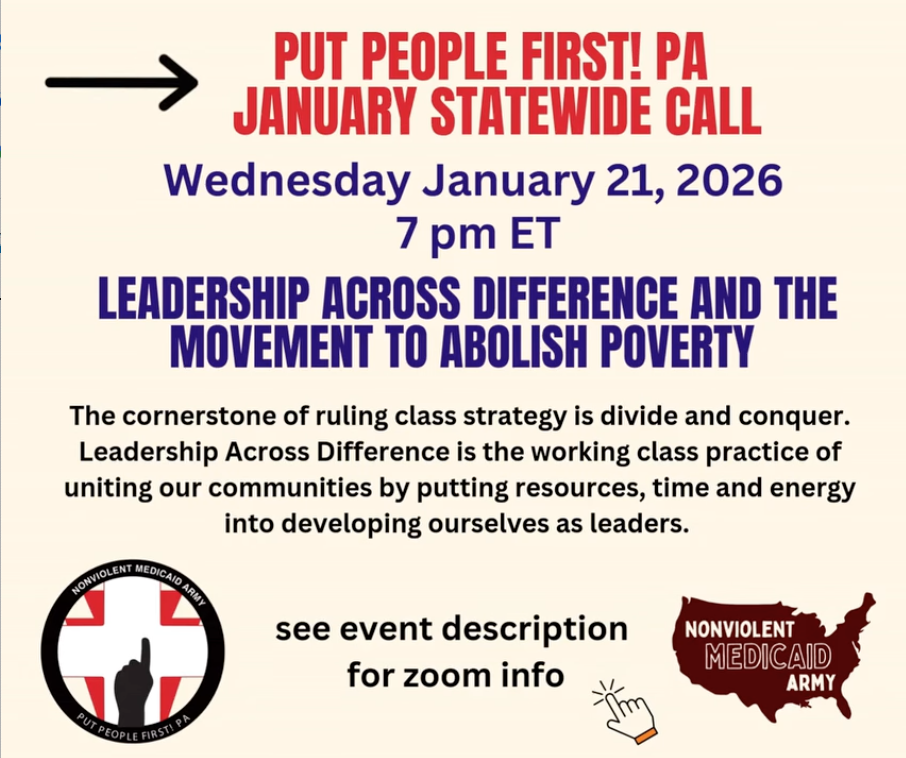
Leadership Across Difference and the Movement to Abolish Poverty
Every third Wednesday of the month from 7-8 pm ET, Put People First! PA, a statewide, member-led, staff-free organization holds our Statewide Membership Call. This call is for active members, mobilizers, and anyone who is interested in finding out more about our Healthcare is a Human Right campaign and getting involved!
The cornerstone of ruling class strategy is divide and conquer. But how do we unite when we’ve been divided for so long, and treated unevenly? Leadership Across Difference is the set of ideas and concrete actions that allow us to develop solidarity across lines of division. Our unity is the necessary foundation to building a movement to abolish poverty. Find out more about what that means on January’s statewide call!
As always, we’ll share our stories of struggle.
Remember – we only get what we’re organized to take!
Click here to join: https://zoom.us/j/5483957623 Or to call in, Dial: 646 558 8656 (US Toll) Then enter Meeting ID: 548 395 7623
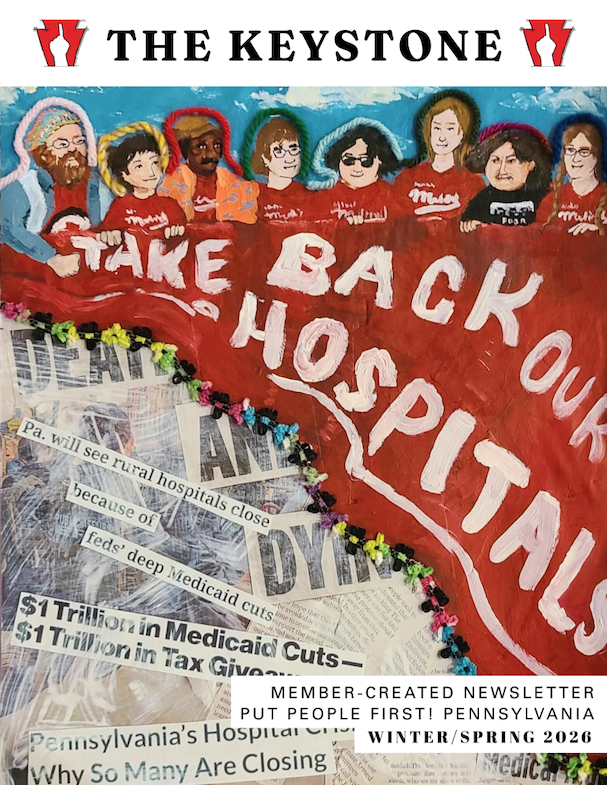
Hot off the press: The Keystone Winter/Spring 2026
Put People First! PA’s member-created newsletter!
The Media & Communications Team of Put People First! PA is proud to announce our latest edition of the The Keystone, our member created newsletter.
The Keystone makes the invisible visible through member stories, reports on base building and campaign activities, lessons on the terrain and leadership development, arts, culture & more. This edition is 44 pages covering activities across rural, urban and suburban Pennsylvania as well as highlights from across the country and internationally. Upwards of 75 people worked on content for The Keystone in one way or another for this publication, and you will find the edition is richer because of it!
Join Put People First! PA on Thursday, January 22nd at 6 PM on Pennsylvania Association of Staff Nurses & Allied Professionals (PASNAP)’s Save our Healthcare Forum in South Philly. Southeast PA Healthcare Rights Committee leader Robin will be repping Put People First! PA on the panel and share how cuts to Medicaid have hurt our families, and how we’re fighting back for our healthcare rights!
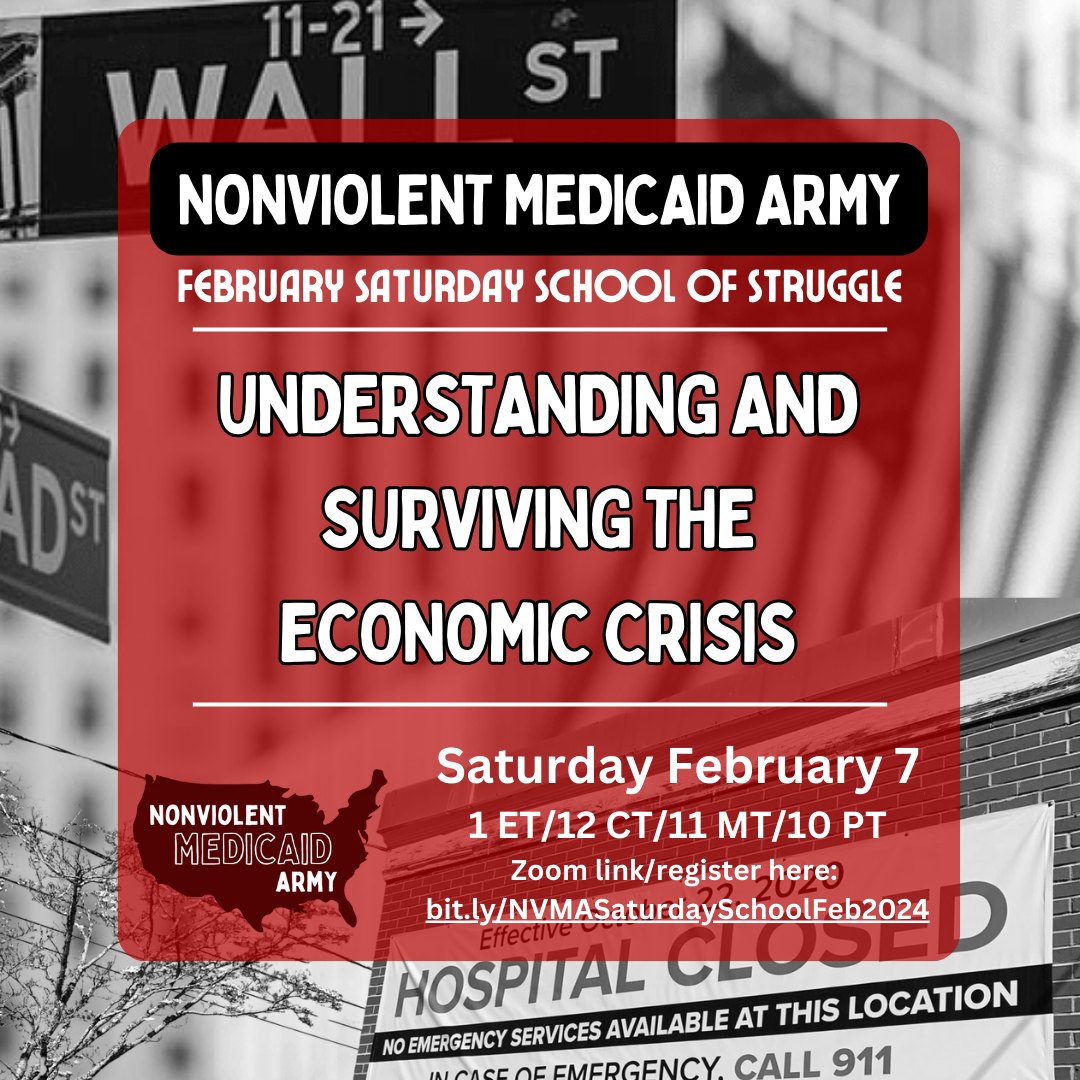
Join us for the February 2026 Saturday School of Struggle
Understanding and Surviving the Economics Crisis
What’s going on with the economy? Why do we hear more reports about what’s happening with the stock market than we do about what’s happening to everyday people? The economy is treated like the weather, it’s made to seem natural and untouchable. It’s made out to be intimidating, and it’s one of the topics that working class people are deliberately taught to feel intimidated by. We reject this! We have to understand the foundations of the society that we live in.
The February Saturday School with the Nonviolent Medicaid Army will look at what’s going on with jobs, prices, debt, and AI. We’ll talk about what’s really going on with our families and communities when it comes to the economy and our ability to survive. We’ll look at how we can unite for support, survival and strategy to get through this deepening crisis and build our movement to abolish poverty.Click here to RSVP & share on facebook.
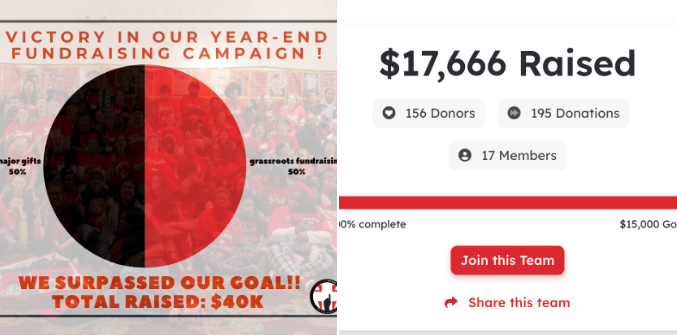
VICTORY in our year-end fundraising campaign!
Thank you to all contributors, supporters, and fundraisers! Our crew of 17 Put People First! PA leaders collectively raised more than $17k. Additional donations came in through check and venmo, bringing the total of grassroots fundraising to 20k. Major gifts were also donated in the amount of 20k bringing our year-end fundraising total to $40,000!!!
Put People First! PA is member-led and staff-free. All of our resources go to gatherings like our yearly Membership Assembly, carrying out our Healthcare is A Human Right Campaign across the state, Community Care funds, childcare, printing, permits, People’s Clinic supplies –> in other words DIRECTLY into building our politically independent working class movement.
This campaign victory represents almost 1/3 of our yearly budget.
Put People First! PA is organized into five regions: Southeast, Southwest, Central-Appalachia, South Central and Northeast. In each of these regions, members participate in twice a month meetings held by phone and online, organized around our healthcare struggles. If you’re new to Put People First! PA, attend a monthly Statewide Call or Saturday School or contact any of the Coordinators listed here to learn more.
The Put People First! PA Media & Communications Team is proud to announce the publication of our member-created newsletter, The Keystone Winter/Spring 2026 edition.
The Keystone aims to “make the invisible visible” through member stories, reports on base-building and campaign activities, lessons on the terrain and leadership development, arts, culture & more! This edition is 44 pages covering activities across rural, urban and suburban Pennsylvania as well as highlights from across the country and internationally. Multiple articles and testimonies are printed in Spanish and English. Every piece includes QR codes and links to see additional photos, resources and learn more. Upwards of 75 people worked on content for The Keystone in one way or another for this publication, and you will find the edition is richer because of it!
To paraphrase Poor People’s Campaign leader, Rev. Barber, we know that to change the narrative on the poor, we need to change the narrator. The Keystone is written by regular people who know from our own survival struggles what we’re up against and what we need to change things. Read the introduction of the edition below!
November 1, 2025 in the U.S. brought the reality of hunger and more intense poverty for over 40 million people, with the failure to load SNAP cards and the specter of work requirements that will only work to hurt more of us. Meanwhile, we continue to suffer bipartisan Medicaid purges, rising ACA premiums, and mass closures of our hospitals. These attacks on our class have occurred under both parties of Wall Street, and they are only intensifying. The 140 million people in and near poverty continues to grow—and 800 people die of poverty every day—in the richest country in the world. This same country is dragged along by a war economy that can always find money to divide us along racial, religious, cultural, geographical, and national lines. It wages attacks on our entire class, from Palestine, to Venezuela and Cuba, and right here on our own soil.
It feels like the poor and dispossessed working class is in a struggle for survival with the billionaires and their minions, who are trying to suck the air out of our lives. Many of us are deprived of our human rights to food, decent housing, medical care; some are kidnapped, incarcerated—even beaten, or killed. Misery and cruelty are the order of the day, all in the name of greater profits for the few, the top 10 of which grew their hoards by $698 billion in the last year alone. With the development of AI, our labor is less and less necessary.
So, we continue to unite, develop ourselves as leaders, and organize. The only thing that will save us is our own organization and unity as the poor and dispossessed—as the working class in the U.S. and around the world. In the face of bullets, raids and the denial of our basic needs, we choose the weapons of revolutionary love, political independence, and care for each other across any and all lines of division.
As one of our members put it: “The oppressors may have the pen, purse, and sword. But we have hearts to care and love one another, our minds for understanding what is truly right, and our hands to reach across the lines of separation.”
Here, we affirm our right to our own narratives. The Keystone is a statement that we need our own voices uplifted to change this system and a tool to build towards a revolution of values. This issue is dedicated to our members—experienced, new, and those yet to join. With each other, we can build a politically independent movement across all lines of division with solidarity for our class to end misery and to organize society around meeting the vast majority’s needs and a livable future.
— Members of the Put People First! PA Media & Communications Team
Introducción
El 1 de noviembre de 2025 en los Estados Unidos trajo consigo la realidad del hambre y una pobreza aún más intensa para más de 40 millones de personas, con la imposibilidad de recargar las tarjetas SNAP y el espectro de los requisitos laborales que solo servirán para perjudicarnos aún más. Mientras tanto, seguimos sufriendo purgas bipartidistas de Medicaid, el aumento de las primas de la ACA y el cierre masivo de nuestros hospitales. Estos ataques a nuestra clase se han producido bajo ambos partidos de Wall Street, y no hacen más que intensificarse. Los 140 millones de personas que viven en la pobreza o cerca de ella siguen aumentando, y 800 personas mueren cada día por culpa de la pobreza, en el país más rico del mundo. Este mismo país se ve arrastrado por una economía de guerra que siempre encuentra dinero para dividirnos por motivos raciales, religiosos, culturales, geográficos y nacionales. Lanza ataques contra toda nuestra clase, desde Palestina hasta Venezuela y Cuba, y aquí mismo, en nuestro propio territorio
Parece que la clase trabajadora pobre y desposeída está librando una lucha por la supervivencia contra los multimillonarios y sus secuaces, que intentan quitarnos el aire que respiramos. Muchos de nosotros estamos privados de nuestros derechos humanos a la alimentación, a una vivienda digna y a la atención médica; algunos son secuestrados, encarcelados, incluso golpeados o asesinados. La miseria y la crueldad son la orden del día, todo en nombre de mayores ganancias para unos pocos, cuyos 10 principales aumentaron sus fortunas en 698 mil millones de dólares solo en el último año. Con el desarrollo de la inteligencia artificial, nuestro trabajo es cada vez menos necesario. Por eso, seguimos uniéndonos, desarrollándonos como líderes y organizándonos. Lo único que nos salvará es nuestra propia organización y unidad como pobres y desposeídos, como clase trabajadora en los Estados Unidos y en todo el mundo. Ante las balas, las redadas y la negación de nuestras necesidades básicas, elegimos las armas del amor revolucionario, la independencia política y el cuidado mutuo más allá de cualquiera línea divisoria.
Como dijo uno de nuestros miembros: «Los opresores tienen la pluma, la bolsa y la espada. Pero nosotros tenemos corazones para cuidarnos y amarnos unos a otros, mentes para comprender lo que es verdaderamente correcto y nuestras manos para tender puentes más allá de las líneas de separación».
Aquí afirmamos nuestro derecho a nuestras propias narrativas. Nuestro boletin “The Keystone” es una declaración de que necesitamos alzar nuestras propias voces para cambiar este sistema y una herramienta para construir una revolución de valores. Este número está dedicado a nuestros miembros, tanto a los veteranos como a los nuevos y a los que aún no se han unido. Juntos, podemos construir un movimiento políticamente independiente que trascienda todas las líneas divisorias, con solidaridad hacia nuestra clase, para poner fin a la miseria y para organizar la sociedad para garantizar las necesidades de la gran mayoría y un futuro digno y sostenible.
— Miembros del equipo de Media y Comunicaciones de ¡El Pueblo Primero! PA

 February Statewide Call: Advocating for your Welfare Rights