Doctoring as a Revolutionary Act
by Taka Yamaguchi, Massachusetts Nonviolent Medicaid Army
“I need you to survive”
I need, you to survive (A)
I need you, to survive (B)
The question is not how to doctor in an anti-capitalist way (A).
The question is how to make doctoring revolutionary (B).
Being a care worker and especially a doctor in our society is commodified and transactional.
Commodified= interchangeable measured units to be traded and therefore profited off of
Transactional= services rendered and services received, time-bounded
“A” is a technical question about how to decouple healthcare delivery from the capitalist mode of production. I’ve thought about this question for years, considering different models of healthcare delivery such as not taking insurance and using sliding scale payment supplemented with grants, etc. But it does not get at the transactional relations between “doctor” and “patient” which are baked into our society and therefore requires a larger framework to change.
“B” is a relational question. It asks, how can healthcare delivery go beyond changing the cash flow, and use the practice of “doctoring” to subvert the inhuman relationship that underlies capitalism, and to model a more human relationship for society.
Inhumanity in our society takes many forms. The obvious ones are the inhumanity that makes us look away from suffering, the inhumanity that reassures ourselves that it cannot happen to us–that it is a “them” problem, the inhumanity that makes us numb to others’ suffering in order to protect our psyches against the relentless suffering. Inhumanity also underlies liberal approaches to the alleviation of suffering. This form of inhumanity is based in pity, perhaps a sense of charity, and even a sense of goodness or ethical obligation. These ethics are still inhuman because they create a separation between the haves and have-nots. To look upon a fellow human like this is to not consider them as part of yourself, as part of a whole that includes you.
In this way even the most “social justice” oriented doctor is often acting in an inhuman way. It makes the doctor exceptional and from there the doctoring itself becomes not just an identity, but an end goal in of itself. A skill to be sharpened, a task to be performed. But I think a human (humanist?) doctor would be using their experience and skills as a conduit to become more human, to act out a mutual flourishing of our most human selves, stifled in this inhuman society.
Can a revolutionary form of doctoring make two people mutually interdependent? I think so.
The first time I saw this in action was in Palestine. I witnessed Palestinian doctors taking care of their fellow people not out of self-interest, not out of self-righteousness, but out of love. A different kind of love than that for a dear friend, or a lover, or family, but an urgent, righteous love. In genocide, the stakes are higher. Every life saved is an act of collective resistance. In every interaction, both healer and healed are reaffirmed as human while the entire world attempts to dehumanize them. Without the healed, the healer has no purpose. They might as well not exist.
A truly human community must share an unshakable faith: every single person not only matters, but is essential to collective survival, is essential to personal survival. The person in front of me must survive in order for me to survive. The act of survival is an act of reciprocity. I need you to survive. You need me to survive.


Consider the healer of pre-capitalist communities–such a role existed in all societies; depending on the geography it may exist now, or it may have been crushed millenia ago. The healer did not share their experience and skills because they expected to receive immediate returns, by and large. Neither did they give care because they wore an outfit that identified them as a healer and thus fulfilled their expected social role–this I believe is true of many doctors today. The healer healed because if they did not heal the farmer, they would starve. If they did not heal the builder, they would have no roof over their heads. In turn, if the farmer did not feed the healer, they would die of an infected snakebite. If the builder did not build for the healer, the builder’s broken arm would reharden misaligned, leaving them unable to build.
They understood that each others’ survival was dependent on everyone in the community being able to participate fully. This is a human relationship founded in love, not based on ethical ideals that it’s the “right thing to do,” but because to do otherwise was to perish alone. We know this to be true, because those who would not follow these social norms of reciprocity were cast out.
In modern capitalist society, individual survival is decoupled from collective survival. Now we praise the most inhuman and cast out those who fight to stay connected to their humanity.
We’ve used technology–physical, social, and economic technologies–to carve out physical survival in a radically different way than at any point in the preceding 500,000 years of human history. We fill our bellies with food, build shelter from the elements, even procure lifesaving medication, while our souls starve. We train ourselves to be something other than human, pretending we’re satisfied with this simulation of a fully human life. We are considered no different than machines, AI that requires carefully titrated inputs of water and food. We denigrate our innate human desire to depend and be depended upon as weakness, when in fact it is strength, a safety net that is not dependent on the whims of the rich.

Increasing numbers of us struggle to survive our death-dealing system, dealt through hypothermia in the streets, bombs on our heads, by drowning in impossible debt, or by our own shaking hands. The only way out is to organize ourselves, the poor and dispossessed, to build a united front of humanity, of human-ness. That includes those of us who are eking out a life that may be occasionally materially comfortable, but seems to leave us always wanting more, never satisfied. We ask ourselves, “is this it? Is this all that life has to offer? Some fancy toys, a few loved ones, and an unshakable sense that being alive should feel less like a battle, a chore?”
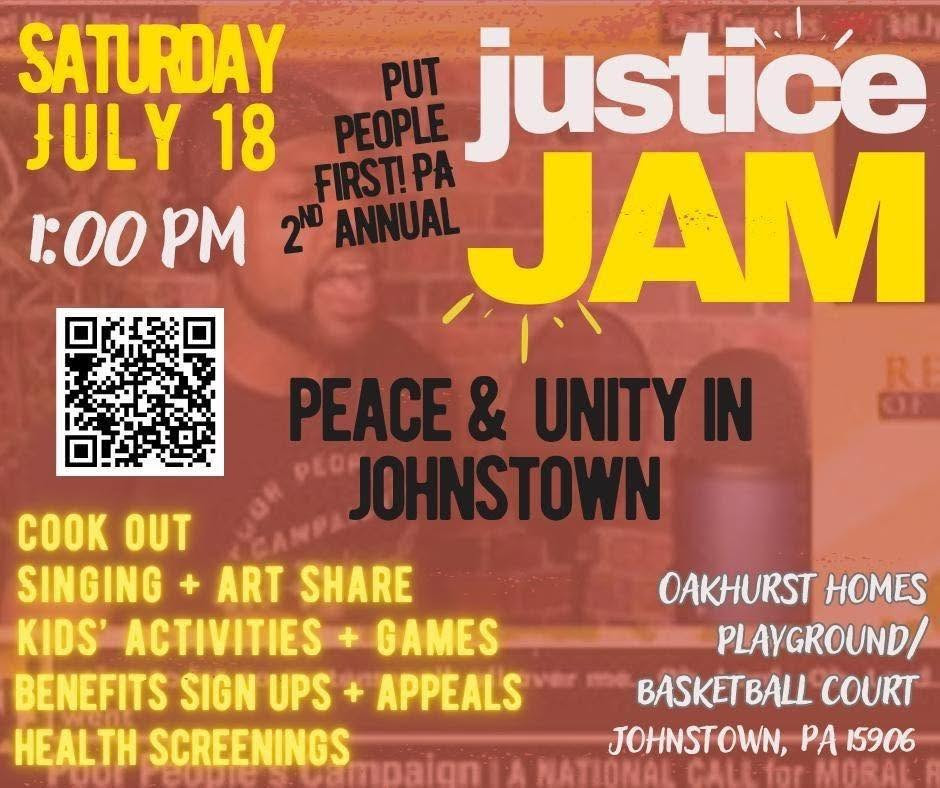
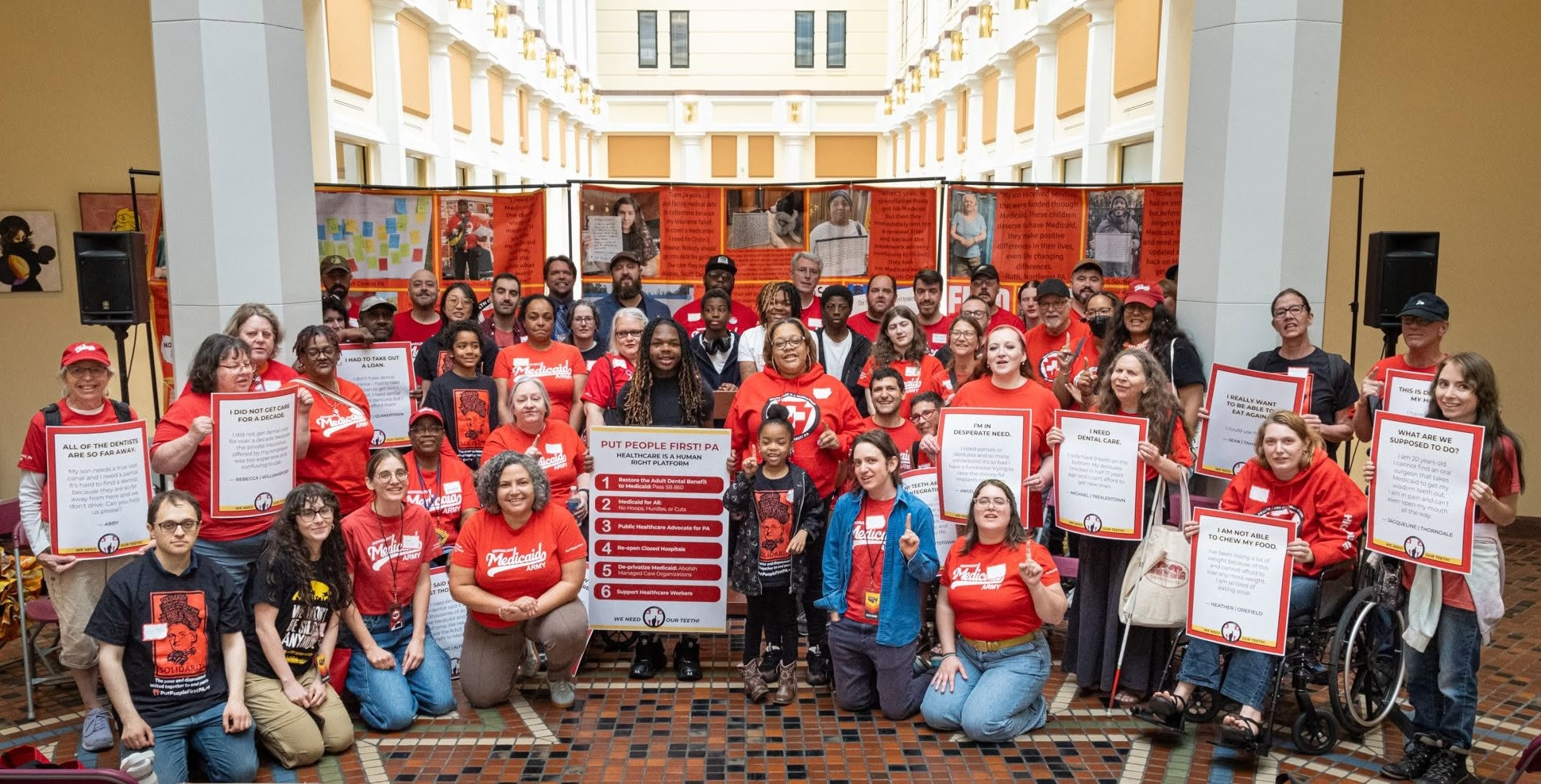
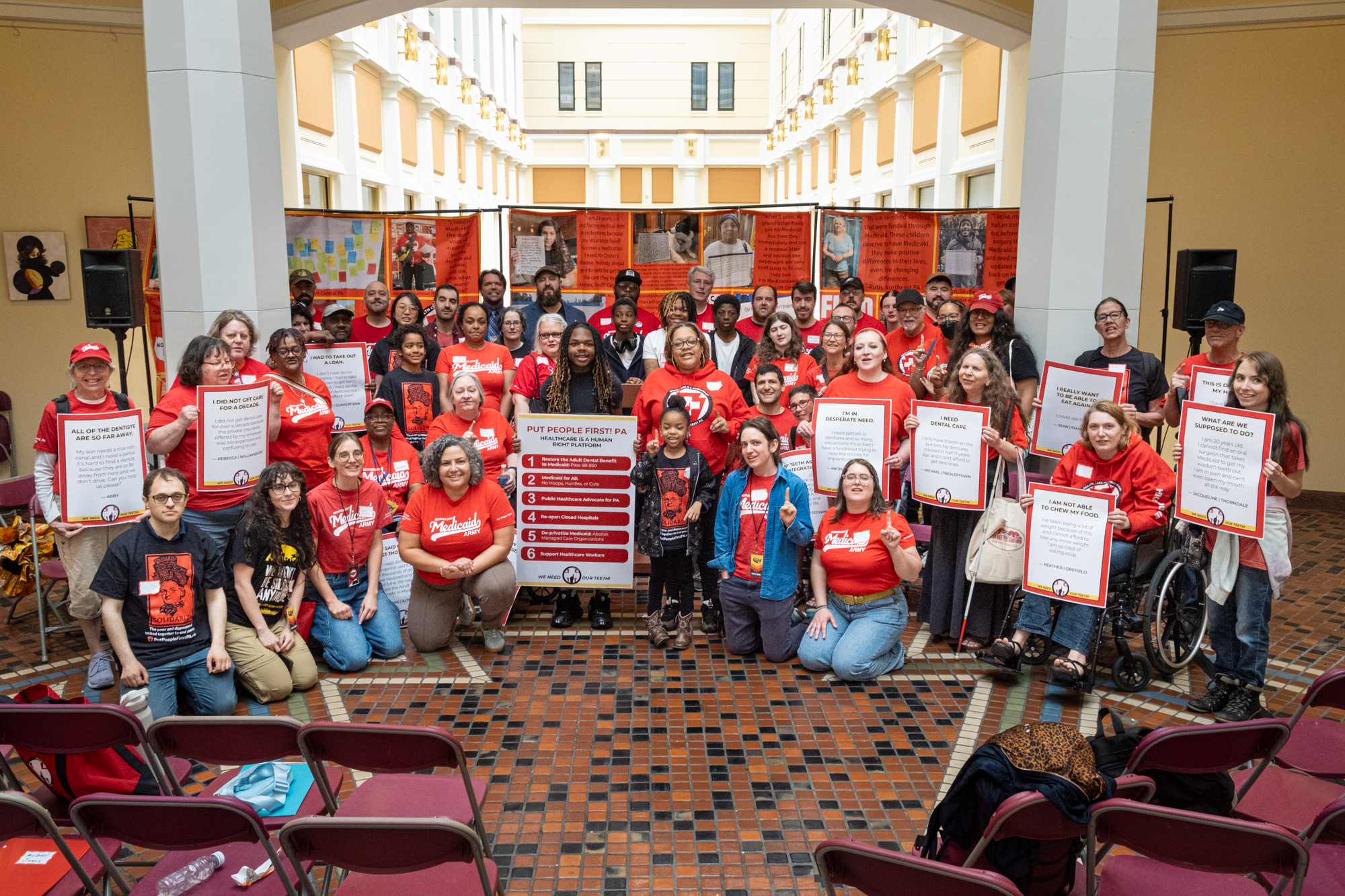
Our ruling class system has taught us that this inhuman state of existence is normal. But this past weekend at the Put People First! PA assembly reaffirmed my belief that inhumanity is not only violent and unnatural, but that we can re-learn to be human with each other. Among my roles, I was on the Health and Safety base group. In the days before the assembly, each of us in the base group were assigned to twelve “buddies” to check in on, confirm they received their COVID tests. During the assembly, we continued to check in on our buddy. All of this was done so that everyone could participate as safely and fully as possible.This was not to make sure they got their money’s worth or because we wanted to ensure a full room for the cameras. It is because every single person in the room has a story to share, everyone has a role to play, everyone is essential to making the assembly a success. Everyone depends on everyone else. If we are going to build a united movement of the poor and dispossessed, we need every single person to be fully present. It is a strategic necessity, practiced in real-time at the assembly.
A series of interactions drove this point home for me, and shook my perspective around “doctoring” to its core. A fellow leader, who had injured his knee a few weeks ago, was suffering from a flare of knee swelling as a result of an unexpectedly long car ride to the assembly. As one of the medical consults for the Health and Safety base group, I was asked to go check in on him in his hotel room. This was ten minutes before the panel on hospital closures was set to start, for which I was nervously awaiting to speak on. So I followed his worried partner to his room, and I was slightly annoyed and significantly anxious. I asked him to lay in bed, I examined his knee and asked him a few questions to reassure that he did not have any worrying symptoms of an urgent complication. I advised him to elevate his seat with cushions so he would not have to bend his knee in order to prop it up, to try gently massaging his knee with a warm towel, and told him that I would request a first-floor room so that getting up and down stairs to the main ballroom would not be a barrier to his participation.
I half-jogged, half-ran back to the ballroom so that I would be on time for the start of the panel, out of breath and brain spinning. I was introduced, not by my unadorned first name, but as Dr. Taka Yamaguchi, which made me uncomfortable because I’ve always associated that title with being exceptional, rather than a neutral descriptor for a certain set of experiences and skills. I started speaking about how the closure of children’s hospitals was disastrous to pediatric care. During my tirade against the inhuman healthcare system, I spotted my very recent patient, my fellow leader with knee pain, listening in the back with some ergonomic adjustments. At that moment, something clicked in my head. My doubt melted away.
I was overcome with love for my friend with knee pain. Or perhaps not quite love, since I had literally known him for twenty minutes, but connection, interdependence. I was so happy to see that he had made it to the ballroom, to participate, to learn and to share his learning with the others at his table or his community back home. I realized I was up there in his hotel room minutes before not because that was my assigned task, or because I happen to have this set of skills and education, but because I felt that his participation, just like everyone else’s participation, was essential to building the movement.
Our capitalist, inhuman society teaches us that some people matter more than others. It is a revolutionary idea to assert that we need all of us, that no one is less important than anyone else. And neither is this hollow idealism, some dressed up egalitarianism. This is based on a realistic assessment of what we’re up against, and it is deadly serious. In our movement to abolish poverty, we need everyone because only with everyone can we win, can we fight back against the inhuman ruling class. To leave some behind is to leave behind the most powerful weapon we have, of interdependence, of solidarity, of humanity. Does that mean that we need 8 billion people in a room before we can wrest power from the 100,000 people currently who own the world? No.
We need to practice reclaiming our humanity, to connect deeply with more and more people, so that we can get better and better at it. The forging of interdependence, of building our own safety net, is a means to an end. The revolution we seek is one to take back our humanity which has been stripped from us, to relate to each other as we used to. The ruling class does not expect us to use what they view as a weakness–stopping to lift everyone up instead of climbing over each other–against them.
At the assembly, I started to understand how caring for someone, in my case doctoring, could reflect that revolutionary value. I am doctoring because I depend on your presence, your survival, so we can all win the world we want. I am doctoring because the act is essential to me, because you are essential to me. You are part of my humanity, and I am part of yours. Only by internalizing that unity can we win against the disunity that threatens the very thing that makes us human. Without you, we will lose. I need you to survive.
*******
Taka Yamaguchi (he/him) is a member of the Massachusetts NVMA. He is a practicing pediatrician at Boston’s largest safety net hospital, and dreams of a national healthcare system that is accountable to human beings, not its shareholders. [Photo left to right: Jacob, Zevi, Taka]


April Statewide Call: Medicaid for All! Abolish Managed Care to Stop the Cuts


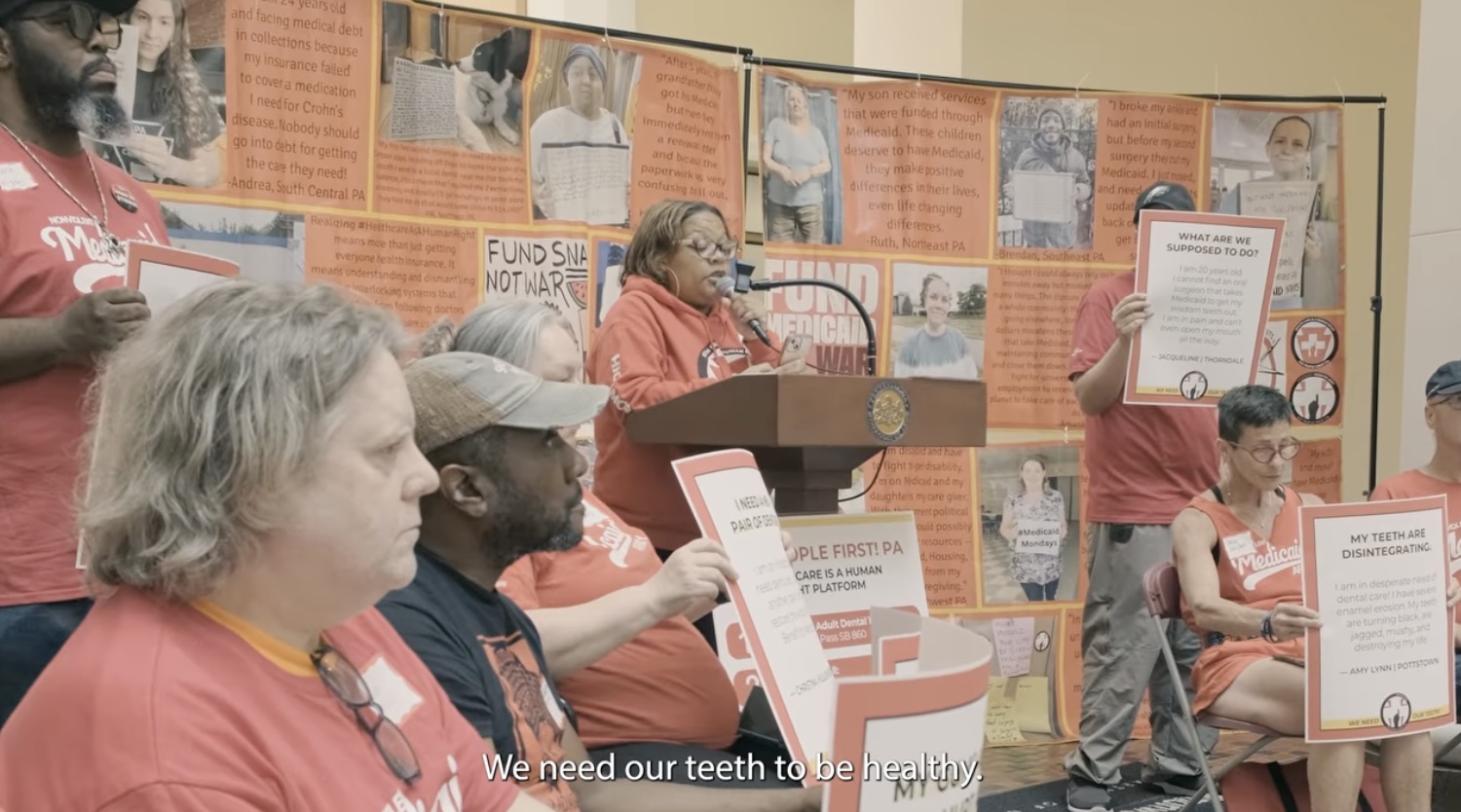
🆘 We’re demanding the PA Senate pass SB 860 to bring back the Adult Dental Benefit in Medicaid and *drop* the Benefit Limit Exception (BLE). This legislation passed the PA House, and now we need to the PA Senate to do their jobs!