
Press Coverage: The Medicaid unwinding: Some 31% of renewals processed so far have resulted in lost coverage
June 28, 2023 · Put People First! PA Admin
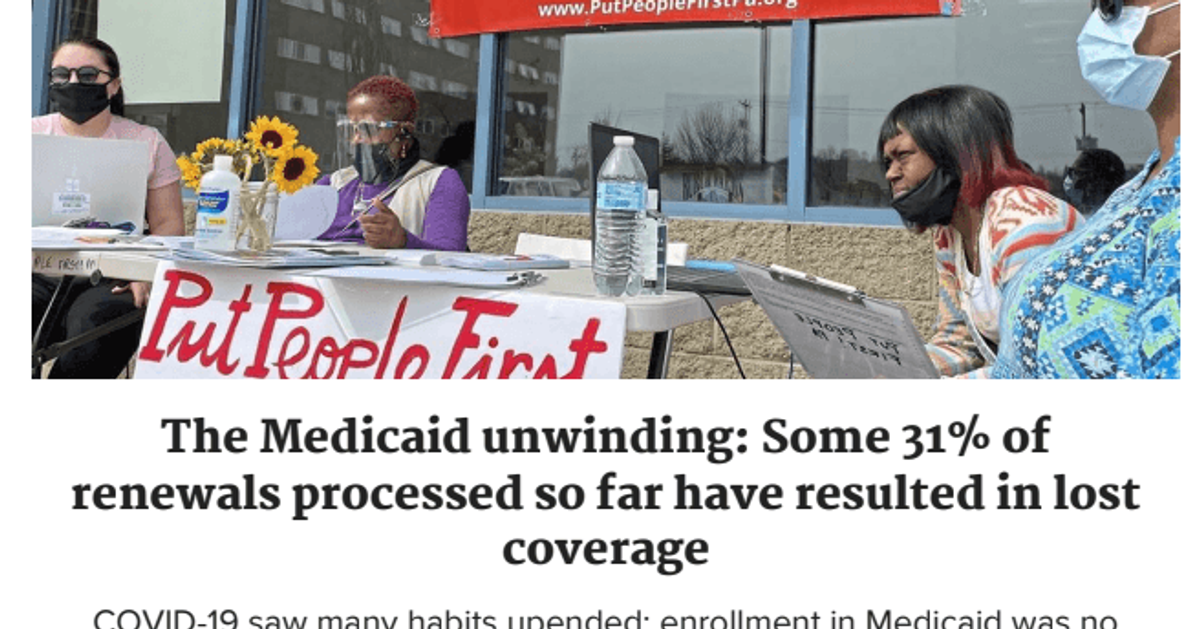
The Medicaid unwinding: Some 31% of renewals processed so far have resulted in lost coverage
COVID-19 saw many habits upended; enrollment in Medicaid was no exception
POLLY HIGGINS Pittsburgh Post-Gazette phiggings@post-gazette.com
JUN 15, 2023 9:54 AM
Tammy Rojas was “stressed out of my mind.” They had one week to complete their Medicaid renewal, and technology was not on their side. “I was stressing and scrambling to get the stuff done,” the Lancaster resident, 46, said. “I went on the website, but the part to file renewals wasn’t working. … I thought to myself, ‘You’ve got to be kidding me.’”
Mx. Rojas, who works at a shelter for people experiencing homelessness, is one of millions of Pennsylvanians once again navigating the Medicaid reenrollment process. In regular times, reupping is an annual ritual, like filing taxes. But COVID-19 saw many habits upended, and enrollment in Medicaid, known as Medical Assistance in the Commonwealth, was no exception: Under the Consolidated Appropriations Act, millions of Americans were afforded continuous coverage, so they were automatically reenrolled in the free medical insurance. Those pandemic-era protections ended on March 31, leaving the more than 93 million people enrolled in Medicaid and CHIP nationwide, as of February, with the task of determining their renewal dates and filing by their individual deadlines. The number of Medicaid recipients coming out of the pandemic is unprecedented, as is the process of “unwinding,” or shifting such a mass of people from a three-year pause back to the rhythms of an annual enrollment cycle. Mx. Rojas, a volunteer with health care activist group Put People First! PA, was reenrolled — “I got lucky” — but not everyone will be. Or has been.
The Biden administration sent up a flare on Monday, concerned about the large number of Americans who have already been disenrolled for largely administrative reasons, such as not having a current address on file.
“I am deeply concerned with the number of people unnecessarily losing coverage, especially those who appear to have lost coverage for avoidable reasons that State Medicaid offices have the power to prevent or mitigate,” Health and Human Services secretary Xavier Becerra said in a June 12 letter to governors.
More than 1 million have lost coverage Approximately 31% of renewals processed so far have resulted in a loss of Medicaid or CHIP coverage, per the Centers for Medicare & Medicaid Service. CMS, through a spokesperson, declined to offer the actual number of people cut off, though the Kaiser Family Foundation, which maintains a Medicaid Enrollment and Unwinding Tracker, counts more than 1 million people who have lost coverage, based on data reported by 21 states. In Pennsylvania, the hard number is 15,560, per DHS’s most recent report in mid-May. They “have been determined to be ineligible for Medicaid, either because of information in their renewal or because they did not return a renewal,” a DHS spokesperson said in an email. While states are in charge of their Medicaid programs, including the logistics of the reenrollment process, they self-report data to HHS. That process makes for a lag in numbers being publicly reported, so it’s difficult to have a crystal clear sense of the actual scope of those being disenrolled. Mr. Becerra reminded governors of so-called flexibilities offered to each state throughout the reenrollment process. For example, most states, including Pennsylvania, have chosen to spread the undertaking across 12 months. HHS also announced an expanded list of flexibilities, which now includes a suggestion to reenroll someone “if able to do so based on available information.” While those new options are currently being reviewed by the state, a DHS spokesperson said, the original list had been discussed “fairly extensively.” And some recommendations, such as renewing people based on eligibility for other programs, such as SNAP, are already part of DHS’s approach. “DHS has similar processes in place already because Pennsylvania currently aligns case processing as much as possible for households participating in multiple programs,” the spokesperson said. With DHS data reported through mid-May, more than 1.3 million people make up the “total maintained population,” which consists of 1,245,424 individuals who have yet to complete a renewal and 77,129 who have. Pre-pandemic, some 17 million people had their Medicaid or CHIP coverage terminated every year, per a CMS spokesperson, “some because they’re no longer eligible, but others because of red tape.” Multiply that number by three (years), and the country is looking at, potentially, more than 50 million terminations. Awareness efforts crucial to renewal process A huge component of the reenrollment process is education, and not merely in terms of the administrative how-tos. A large swath of Medicaid recipients don’t even know the unwinding is occurring. “A recent survey of Medicaid enrollees found that two-thirds of people were not sure if their state was returning to regular Medicaid operations,” Mr. Becerra stated in his letter. Awareness efforts have been baked into the unwinding, including advertisements put out both by the state and CMS. A DHS spokesperson said Pennsylvania had been planning for the return to annual reenrollment of Medical Assistance and CHIP for more than a year. The state’s DHS, the spokesperson said, “continued to send annual renewal packages to Medicaid recipients throughout the pandemic, even though no action would be taken on their coverage if they were no longer eligible or if they did not return their renewal.”
But the obstacles for reaching those most vulnerable are many. Children enrolled in CHIP are of particular concern, as are people without stable home addresses. “We are really focusing on folks with language barriers, also folks who don’t have access to online capabilities, and those who aren’t receiving their mail … and those who truly don’t know they’re up for renewals,” said Tia Whitaker, statewide director of outreach and enrollment with Pennsylvania Association of Community Health Centers. Creative outreach solutions are threaded through the federally suggested flexibilities, and they’re also being employed by community-level groups. One such organization takes the meet-people-where-they-are approach by educating folks about health care in laundromats. Fabric Health first came to Pittsburgh in December, per co-founder Allister Chang, after launching in Philadelphia earlier in 2022. Representatives with the nonprofit can be found in five laundromats in the Pittsburgh area. Though Fabric Health helps clients with an array of health care issues, the Medicaid unwinding has been a priority. “We’ve been doing a lot of education and outreach around this because a lot of Medicaid recipients don’t know quite what’s happening,” said Jacob Hope, a health policy specialist with Fabric Health. “There are plenty of people it is actually a big issue for,” Mr. Hope said, citing individuals who have fluctuating incomes and/or move often. “You have to send pay stubs, you have to send in this packet. … There are a lot of administrative hurdles or burdens on people. That’s common.” ‘I wasn’t sure what I would do’
For Gary Rush, of Dormont, the first hurdle was a letter he said he received stating he was going to lose his coverage. “I must of gotten a letter on a Saturday. I didn’t open it up until Monday night. It said I was going to lose my health coverage on April 20, which was only a few days away,” Mr. Rush, 67, said.
Enrolled in Medicaid since before the pandemic, Mr. Rush, who is dual- eligible for Medicare, wasn’t entirely clear why he was denied coverage.
“I guess it was one of my retirement funds,” he said of modest savings including a 401K. He’s been on disability, he said, due to chronic back pain that required surgery about five years ago and diabetes. Encouraged by his mother to reach out to Put People First! PA, Mr. Rush connected with the grassroots organization for assistance with filing an appeal. With that all-volunteer group’s help, “In one day we were able to file the appeal. I wasn’t sure what I would do for health coverage,” Mr. Rush said. Mr. Rush joined about 30 people at a Put People First! rally outside the state Capitol Building in Harrisburg on June 7, condensing his Medicaid story into a minute as he told those gathered of his many health challenges and the crushing math of his medication (one costs nearly $700) and social security income that doesn’t inch far past. In addition to demonstrations — the Harrisburg event was dubbed “Caroling the Crisis” — the group has spread Medicaid renewal news in myriad ways, from old-fashioned door knocking to a #MedicaidMondays social media campaign that encourages people to share the importance of the insurance to them. An option at the heart of the group’s message would remove the need for reenrollment entirely: Medicaid coverage for all. Mr. Hope, also a volunteer with Put People First!, has been assisting Mr. Rush with his appeal. As he awaits the verdict, Mr. Rush’s Medicaid has remained in place. ‘We have a range of oversight levers’ Adding to the challenges on the enrollee’s part is mere bandwidth on the administrative end. “Honestly, it’s a capacity issue,” said Antoinette Kraus, executive director of nonprofit Pennsylvania Health Access, a Philadelphia-based health care advocacy group, “because there are so many people who have to go through Medicaid renewal.” That stretching of resources, Ms. Kraus said, has manifested in long wait times at call centers. “We just encourage people not to give up,” she said, adding that, if someone’s not sure about their status, a good starting point is the state helpline, 800-692-7462. Medicaid recipients can check their renewal dates at dhs.pa.gov/COMPASS as well. Ms. Kraus noted that, in the weeks leading up to the end of continuous enrollment, PHAN had seen “a definite uptick” in calls for help with the renewal process. DHS said its “call center operations are strong,” with average wait times at five minutes in April, the latest month data is available for. In his letter to governors, Mr. Becerra reminded states of HHS’s regulatory prowess should they be noncompliant with federal regulations, “and individuals must be afforded the due process to which they are entitled in order for states to continue to receive enhanced federal funding.” “We have a range of oversight levers,” explained Dan Tsai, director of the Center for Medicaid and CHIP Services, in a press call on Tuesday.
Center for Medicaid and CHIP Services, in a press call on Tuesday. Should a state not follow the rules, he noted, Mr. Becerra has the authority to place that state under a corrective action plan. Polly Higgins: phiggijns@post-gazette.com First Published June 15, 2023, 8:48am